Chelated Copper EDTA Fertilizer 14% Cu
- Regular Price
- $ 32.99
- Sale Price
- $ 32.99
- Regular Price
- $ 31.99
Sold Out
- Unit Price
- per


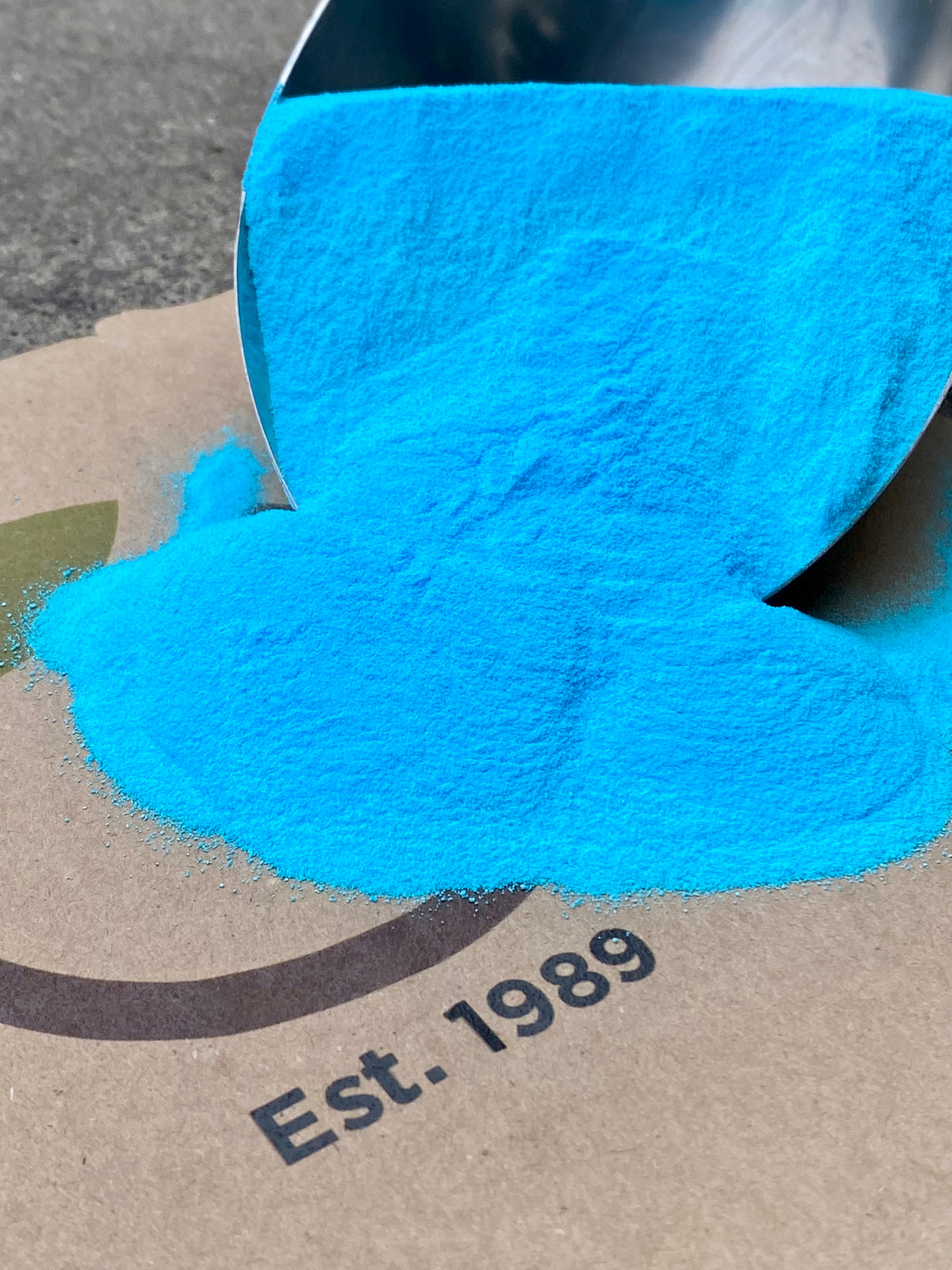


Water-soluble copper micronutrient · 14% Cu · EDTA chelated
Chelated Copper EDTA is a water-soluble copper fertilizer with a guaranteed 14% copper, all of it chelated by EDTA. Use it to correct a copper shortage that a soil or tissue test has confirmed, to the soil, through irrigation, or as a buffered foliar spray, or as the copper ingredient in a complete hydroponic or fertigation recipe. It is a single micronutrient, not a complete fertilizer.
Its most important limitation is the nutrient itself. The margin between enough copper and too much is narrow, excess copper injures plants, and copper applied to soil stays there for years. Let a laboratory result, not a symptom, decide whether you need it.
| Specification | Detail |
|---|---|
| Copper (Cu) | 14.0% |
| Chelated copper (Cu) | 14.0%. The label declares all of the copper as chelated. |
| Derived from | Copper EDTA (copper ethylenediaminetetraacetate). The safety data sheet identifies the material as disodium copper(II) EDTA, CAS 14025-15-1, at 90–100% of the product. |
| Nitrogen, phosphate, potash | None declared. This is a micronutrient source, not an N–P₂O₅–K₂O fertilizer. |
| Physical form | Blue to blue-green water-soluble powder or granules |
| Solubility | Dissolves readily in water. A clear solution on its own does not guarantee that a mixture with other fertilizers stays clear; see Related products & compatibility. |
| Hazard classification (SDS, December 2025) | OSHA HazCom 2012: acute toxicity, oral, category 4. Signal word Warning; hazard statement “Harmful if swallowed.” |
| Package sizes | 1 lb, 2 lb, 5 lb, and 25 lb |
| Packaged by | Greenway Biotech, Inc., Madera, California |
Percentages are by weight of product: 1 oz of product contains 0.14 oz (4.0 g) of copper, a 1 lb bag contains 2.24 oz (63.5 g) of copper, and a 25 lb bag contains 3.5 lb of copper. Every rate on this page is stated as product weight; the elemental copper it delivers is shown beside it.
Choose this product when a test result, not a symptom, points to one of these situations. Copper deficiency symptoms overlap with other problems, and copper is the micronutrient most worth confirming before you apply it.
Vegetables, field crops, orchards, and vineyards where a soil or tissue test interpreted for the crop shows copper is short. University Extension identifies peat and muck soils, very sandy soils, and high-pH soils as the places copper deficiency actually occurs; soil type alone is not a diagnosis.
A single-nutrient copper source for a complete nutrient program, dosed from a measured stock solution. Account for the copper already in your source water and base fertilizer before adding any.
University of Florida IFAS reports that inorganic water-soluble micronutrients applied to soil are often ineffective and that chelates react less with the soil, with the largest advantage at high pH. That is a reason to choose a chelate for a tested need, not a reason to apply copper without one.
The manufacturer’s directions for this 14% copper EDTA include buffered foliar sprays for vegetable, field, tree, vine, and citrus crops, with per-acre rates, minimum spray volumes, and timing. Foliar copper reaches the leaf quickly but does not build soil copper; use it for the crop and season in front of you.
Every rate below is product weight unless the label prints a volume. Two documents govern this product: the current Greenway package label, which carries soil directions per 1,000 sq ft, and the manufacturer’s label for this same 14% copper EDTA, which carries the complete direction set: soil and fertigation rates per acre, an individual-tree rate per inch of trunk diameter, ornamental and turf directions, and foliar and aerial rates with spray volumes and timing. They are shown separately so you can see which document each rate comes from; the Greenway package rates sit inside the manufacturer’s ranges. University Extension context is listed in section 13. Apply any of these only where a soil or tissue test, or crop-specific guidance, shows copper is needed.
Weigh it. Copper doses are small and this product’s density has not been measured, so no gram equivalent is given for the tablespoon and teaspoon measures the manufacturer prints for ornamentals and turf; use those measures as printed. Everything else is weighed: a scale reading to 0.1 g for garden and tree amounts, and the stock-solution method for reservoirs.
| Crop group | Label rate per 1,000 sq ft | Same rate per acre | Elemental copper per 1,000 sq ft | Apply only when | Basis |
|---|---|---|---|---|---|
| Vegetables and field crops | 0.8–1.2 oz (22.7–34.0 g) | 2.2–3.3 lb | 0.11–0.17 oz (3.2–4.8 g) Cu | A soil or tissue test interpreted for the crop shows copper is deficient. One application per tested need; retest before repeating. | Greenway label |
| Tree and vine crops | 0.8–1.6 oz (22.7–45.4 g) | 2.2–4.4 lb | 0.11–0.22 oz (3.2–6.4 g) Cu | Same, over the planted area. For single trees, use the manufacturer’s per-inch direction below. | Greenway label |
| Crop group (as listed on the label) | Label rate | Per 1,000 sq ft | Elemental copper per acre | Method |
|---|---|---|---|---|
| Vegetable crops: beans, carrots, celery, cucumbers, lettuce, melons, onions, peas, peppers, potatoes, spinach, sweet corn, tomatoes | 2–4 lb per acre | 0.73–1.47 oz (20.8–41.7 g) | 0.28–0.56 lb Cu | Dissolve in water or fluid fertilizer, or dry-blend with water-soluble fertilizers, for uniform coverage; or dissolve and meter into drip, sprinkler, or furrow irrigation |
| Field crops: alfalfa, corn, dry beans, peas, forage grasses, rice, safflower, sorghum, sugar beets, sugarcane | 2–4 lb per acre | 0.73–1.47 oz (20.8–41.7 g) | 0.28–0.56 lb Cu | Same |
| Tree and vine crops: almond, apple, apricot, avocado, berry, cherry, citrus, grape, mango, olive, pear, peach, pistachio, plum, walnut | 2–5 lb per acre, or ½–2 oz per inch of tree diameter for individual trees | 0.73–1.84 oz (20.8–52.1 g) | 0.28–0.70 lb Cu | Per acre for a planted block. For individual trees, blend the weighed amount with soil or sand, or sprinkle it directly and uniformly on the soil under the drip line, then water in |
| Ornamental shrubs and trees | 1 tbsp for small shrubs, up to 1 tbsp per inch of tree diameter for large trees and shrubs (volume as printed; no gram equivalent) | — | — | Sprinkle uniformly under the drip line and water in |
| Turf (professional use only) | ½ lb per 10,000 sq ft, or 2 lb per acre | 0.8 oz (22.7 g) | 0.28–0.31 lb Cu | Professional turf managers only, per the label; water in |
Start at the low end of any range unless the laboratory interpretation supports more. Measure the area actually treated, spread the weighed amount uniformly, and water it in; through irrigation, dissolve fully and meter the dose over the same area. Do not concentrate a whole-area dose beside one plant, and do not add automatic repeat soil applications: copper applied to soil is not lost quickly, so retest before any second treatment. A past copper fertilizer or copper-based spray program counts toward what is already there.
For a single tree or vine, the manufacturer’s label gives ½–2 oz of product per inch of trunk diameter (14–57 g per inch). Measure the trunk diameter, multiply, and start at ½ oz per inch unless a crop-specific soil or tissue interpretation supports more. Worked example: a 4-inch-diameter apple tree has a range of 2–8 oz (57–227 g) of product, delivering 8–32 g of copper; begin at 2 oz. Sprinkle it uniformly on the soil under the drip line, or blend it with soil or sand first, keep it off the trunk, and water it in. The per-inch direction is for individual trees; for a planted orchard or vineyard block, use the per-acre rate.
| Crop group | Label rate | Spray volume | Timing and conditions |
|---|---|---|---|
| Vegetable and field crops, ground equipment | ⅓–1⅓ lb per acre (151–605 g) | Sufficient for thorough coverage, 25 gal per acre minimum | When testing or crop guidance shows a copper need |
| Tree and vine crops, excluding citrus | 1–2 lb per acre (454–907 g) | Sufficient for thorough coverage, 25 gal per acre minimum | Dormant or delayed dormant before bloom, then after full bloom at 2–3 week intervals as needed |
| Deciduous crops with fruit present | 1 lb per acre (454 g) | 50–100 gal per acre | Same program, reduced rate while fruit is on the tree |
| Citrus | 1–2 lb per 100 gal of cover spray (4.5–9.1 g per gallon) | Full cover spray | Any time except during bloom |
| Aerial application | ⅓ lb per acre (151 g) | At least 10 gal per acre | Licensed aerial application |
| Turf (professional use only) | General turf 1 tbsp per 1,000 sq ft; golf greens 1 tsp per 1,000 sq ft (volume as printed; no gram equivalent) | Spray to wet | Professional turf managers only, per the label |
For every foliar use: buffer the spray solution to pH 6–6.5, apply enough volume for thorough coverage (the label notes that coverage and wetting agents often enhance uptake), and do not spray plants that are suffering from moisture stress. Start at the low end of a range, test a small area before treating a whole planting, and keep sprays off open bloom on citrus. These are the manufacturer’s directions for this exact analysis; they do not transfer to copper sulfate or to any other copper product.
The manufacturer’s label covers fertigation as a way to deliver the soil rates above through drip, sprinkler, or furrow irrigation. It gives no target concentration for a recirculating hydroponic reservoir, and no single copper concentration fits every crop and program, so this page does not pick one for you. Take the total copper target from your complete recipe, subtract the copper already present in the final solution from source water and the base fertilizer, and dose only the difference. An EC or TDS meter measures total dissolved salts and cannot tell you the copper concentration; that takes a laboratory or a validated copper test.
Measuring stock (1.00 g/L). Weigh 1.00 g of product, dissolve it in water, and make the solution up to exactly 1,000 mL. Each mL of this stock contains 0.14 mg of copper. Stock to add (mL) = additional copper needed (mg/L) × final reservoir volume (L) ÷ 0.14. Label the container with the product, concentration, and date; keep it secured away from children and animals; and use graduated equipment, not spoons. This is a measuring method, not a crop recommendation.
Worked example: a 100 US gal reservoir (378.5 L), recipe target 0.05 mg/L Cu, with 0.02 mg/L already supplied by the water and base fertilizer. Additional copper = 0.03 mg/L × 378.5 L = 11.4 mg, which is 11.4 ÷ 0.14 = 81 mL of stock (0.081 g of product). Dissolve any dry product separately and add it to a dilute, compatible solution; never to a concentrated phosphate or sulfate stock tank.
Formulas. Soil by area: product (lb) = acres × manufacturer rate (2–4 lb per acre for vegetable and field crops, 2–5 lb per acre for tree and vine blocks, ½ lb per 10,000 sq ft for professional turf); square feet ÷ 43,560 = acres; multiply pounds by 453.6 for grams. Individual trees or vines: product (oz) = trunk diameter (inches) × ½ to 2, per tree. Foliar by area: product (lb) = acres × label rate (⅓–1⅓ lb for vegetable and field crops; 1–2 lb for trees and vines, 1 lb with fruit present; ⅓ lb aerial), in at least 25 gal per acre (50–100 gal with fruit present; 10 gal aerial). Citrus cover spray: product (lb) = gallons of spray ÷ 100 × 1 to 2. Reservoir: stock (mL) = (recipe target − copper already present, in mg/L) × final volume (L) ÷ 0.14, using the 1.00 g/L stock.
Worked examples. A 250 sq ft vegetable bed testing low in copper: 250 ÷ 43,560 × 2–4 lb = 0.011–0.023 lb, which is 5.2–10.4 g; a 1 lb bag covers it many times over. One 4-inch apple tree: 4 × ½ to 2 oz = 2–8 oz (57–227 g), start at 2 oz; a 1 lb bag. A 2 acre orchard block by soil at the low end: 2 × 2 lb = 4 lb, so a 5 lb bag; at the high end 10 lb, which takes more than one bag. A foliar spray on 3 acres of tomatoes at the low end: 3 × ⅓ lb = 1 lb in at least 75 gal, buffered to pH 6–6.5; a 1 lb bag. A 100 gal reservoir at a 0.05 mg/L target with 0.02 mg/L already present: 81 mL of the 1.00 g/L stock.
The calculator below applies these directions, shows the full label range with the conservative end as the starting amount, states the copper delivered and, for sprays, the minimum spray volume, and recommends the lowest-price bag combination that covers one application (and the least-leftover combination when that differs). Prices are shown in USD; tax and shipping are added at checkout, and availability is confirmed when you add to cart.
The calculator needs JavaScript. If it does not appear, use the formulas and worked examples above to choose a size.
EDTA wraps the copper ion in a soluble, stable complex. That changes how the copper reacts on its way to the root: it is less likely to be tied up by soil carbonates, phosphates, and organic matter than copper from a simple salt, which is why University of Florida IFAS describes soil-applied inorganic micronutrients as often ineffective and chelates as less reactive with the soil. The stability of any chelate depends on the chelating agent and the pH. EDTA is the weakest of the common iron chelates at high pH because ferric iron is lost from it to hydroxide precipitation; copper is not lost that way, so copper EDTA holds across the usual soil pH range better than iron EDTA does. None of this prevents every form of precipitation or fixation, and it is not a guarantee of a particular pH range in the field.
Inside the plant, copper is a cofactor in photosynthetic electron transport and in enzymes involved in respiration and lignin formation. It is barely mobile once in the tissue, so a shortage shows first in young leaves and shoot tips. Because those symptoms have other causes, and because the gap between deficiency and toxicity is narrow, laboratory interpretation is the reliable way to separate a copper shortage from root stress, another nutrient problem, or a pH effect.
Copper applied to soil persists. It binds to organic matter and clay, is not leached quickly, and accumulates with each application, including copper from fungicidal sprays. That persistence is the reason to size a single tested application rather than a program. The evidence above concerns copper and EDTA chelates generally; it is not a trial of this finished product.
Copper can be supplied several ways, and the right one depends on the test result, the growing system, and what the rest of the program already contains. Analyses are each product’s label guarantee as shown on its page.
| Option | Copper | Choose it when | Limitation |
|---|---|---|---|
| Chelated Copper EDTA 14% Cu, this product | 14% Cu, chelated | A tested copper need in soil, especially at high pH; a buffered foliar correction on a listed crop; or a measured copper line in a hydroponic or fertigation recipe | Still adds to total soil copper; not automatically superior in every soil; foliar use needs a buffered spray and the label’s timing |
| Copper Sulfate Crystals | Copper sulfate pentahydrate, about 25% Cu | An economical soil copper source where the crop guidance recommends copper sulfate, typically on acidic to neutral soil | Use its own analysis and directions; product weights are not interchangeable with copper EDTA. Its other uses on that page are separate use categories. |
| A complete micronutrient blend | Varies; check the analysis | Several confirmed micronutrient needs at once, or an established complete recipe | May already supply all the copper needed; adding this product on top double-doses |
| No additional copper | — | Testing and the existing program show copper is adequate | The right choice more often than not; do not apply copper as maintenance |
For the general comparison of sulfate and chelated forms, read sulfate vs. chelated fertilizers.
The full handling and first-aid directions are in the Safety Data Sheet.
It is a water-soluble micronutrient fertilizer containing 14% copper, all of it chelated by EDTA. Use it to supply copper where a soil or tissue test, or a professionally designed nutrient recipe, establishes a need. It is not a complete fertilizer, a fungicide, or an animal-feed supplement.
Copper deficiency affects young growth: pale or twisted new leaves, weak shoots, and tip dieback. Those symptoms have other causes, and the gap between enough copper and too much is narrow, so have a laboratory interpret soil or tissue results for your crop, sampling stage, and test method before applying any. There is no single soil-test cutoff that applies to every crop and laboratory method.
The manufacturer’s label for this 14% copper EDTA gives 2–4 lb per acre for vegetable and field crops and 2–5 lb per acre for tree and vine crops, which is 0.73–1.47 oz (20.8–41.7 g) and 0.73–1.84 oz (20.8–52.1 g) per 1,000 sq ft. The current Greenway package label prints the same uses as 0.8–1.2 oz and 0.8–1.6 oz per 1,000 sq ft, inside those ranges. Start at the low end unless the laboratory interpretation supports more, spread it over the measured area or meter it through irrigation, water it in, and retest before any repeat. These are product-label directions, not university recommendations.
The manufacturer’s label for this 14% copper EDTA gives ½–2 oz of product per inch of trunk diameter for an individual tree. A 4-inch-diameter apple tree has a range of 2–8 oz (57–227 g); begin at 2 oz unless a crop-specific soil or tissue interpretation supports more. Sprinkle it uniformly on the soil under the drip line, or blend it with soil or sand first, keep it off the trunk, and water it in. For a planted orchard or vineyard block, use the per-acre rate (2–5 lb per acre) instead.
Yes. The manufacturer’s label allows soil applications to be dissolved in water and metered into drip, sprinkler, or furrow irrigation at the same per-acre soil rates. For ornamental shrubs and trees it prints 1 tbsp for small shrubs and up to 1 tbsp per inch of tree diameter for large trees and shrubs, sprinkled under the drip line and watered in; use those volume measures as printed, because no gram equivalent has been measured for this product. The turf directions (½ lb per 10,000 sq ft to the soil; 1 tbsp per 1,000 sq ft foliar, 1 tsp on golf greens) are labeled for professional use only.
Yes, as one ingredient in a complete nutrient recipe. First account for the copper in your source water and base fertilizer, then dose only the difference to the target your recipe specifies. The calculator converts that target into a stock-solution volume; it does not diagnose a deficiency or choose the target for your crop. An EC or TDS meter cannot measure copper separately.
Weigh 1.00 g of this 14% Cu product, dissolve it in water, and make the solution up to exactly 1,000 mL. Each mL then contains 0.14 mg of copper. Stock to add in mL = additional copper needed in mg/L × final reservoir liters ÷ 0.14. Use a scale and graduated liquid equipment, label the stock, keep it secured, and do not estimate with household spoons.
Yes, on the crops the manufacturer lists. Its directions for this 14% copper EDTA are ⅓–1⅓ lb per acre for vegetable and field crops and 1–2 lb per acre for tree and vine crops other than citrus, each in at least 25 gal of spray per acre; 1 lb per acre in 50–100 gal for deciduous crops with fruit present; 1–2 lb per 100 gal of cover spray for citrus, any time except during bloom; and ⅓ lb per acre in at least 10 gal by air. Buffer the spray to pH 6–6.5, cover thoroughly, do not spray moisture-stressed plants, start at the low end, and test a small area first. These directions are for this exact product; do not adapt them from or to copper sulfate.
No. Both supply copper. University of Florida IFAS reports that chelates react less with the soil than inorganic salts, with the largest advantage at high pH, while copper sulfate remains an effective and economical soil source where crop guidance recommends it. Performance depends on the crop, soil, water chemistry, and application method; a fixed absorption advantage or a guaranteed field pH range should not be assumed.
Compatibility depends on the complete formulation, concentration, water quality, and pH. Follow each product’s directions, dissolve ingredients separately, and combine them only in a dilute, compatible solution. Jar-test unfamiliar mixtures at the intended concentration; a clear jar does not establish crop safety. Do not add it to concentrated phosphate or sulfate stock tanks, and do not store a combined concentrate.
Keep the product and stock solutions away from animals, feed, and drinking water; it is not for human or animal consumption. Sheep are especially susceptible to copper poisoning. Do not apply to sheep grazing areas without a livestock-specific assessment from your veterinarian or agronomist. Watering in or drying does not establish a safe grazing interval.
Neither. This product is sold for plant nutrition; it is not registered as a fungicide, bactericide, or algaecide, so do not use it for disease, algae, or pond treatment. EDTA is a synthetic chelating agent, and this product does not carry an OMRI listing or an organic input registration; growers under certification should get product-specific approval from their certifier before use.
Articles give background. For this product, use the directions and documents on this page.
The soil rates per 1,000 sq ft come from the Greenway package label; the per-acre soil, fertigation, individual-tree, ornamental, turf, foliar, and aerial directions come from the manufacturer’s label for this same 14% copper EDTA; and the copper nutrition, testing, chelate, and livestock statements come from the university Extension publications below. They are listed for growers, advisors, and certifiers who want to check them; the Extension sources explain nutrient management and do not certify or endorse this product.
Rates and sources reviewed September 14, 2026.
Not sure whether your test actually calls for copper, or how to read it? Email your soil, tissue, or water results to questions@greenwaybiotech.com or call (562) 351-5168, Monday to Friday, 7 AM to 5 PM Pacific, and we will read them with you. Every order carries a 90-day satisfaction guarantee.
Ready to buy? Calculate & choose a bag
Or choose a package weight from the size selector at the top of this page. Have your crop, growing method, test results, and treatment area or reservoir volume ready; for nutrient solutions, include the other fertilizers and the water analysis.
Greenway Biotech, Inc. is a family-owned fertilizer manufacturer in Madera, California, blending and packaging specialty fertilizers and soil amendments since 1989.